

Short answer: yes, use fabric in a French drain, and use the right kind. That means nonwoven geotextile, lining the whole trench and folded over the top of the gravel. Not woven fabric, not garden-center weed barrier, and not a sock pulled over the pipe. Of all the decisions on a French drain, this is the one that most decides whether it still works in ten years.
What the fabric actually does
A French drain works because water moves easily through the open gaps between clean stones. Soil is the enemy of those gaps. Every rain carries fine silt and clay toward the trench along with the water. With nothing in the way, that silt settles into the stone, the gaps close up, and the drain turns into a buried line of mud.
Filter fabric sits between the soil and the stone. Water passes through it; soil does not. The stone stays open, so the drain keeps draining.
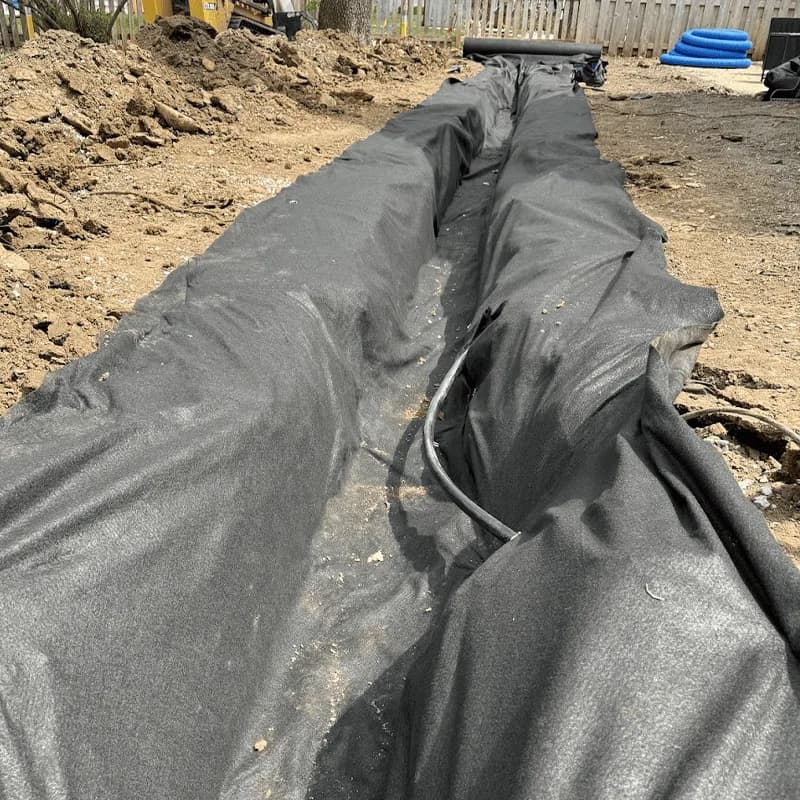
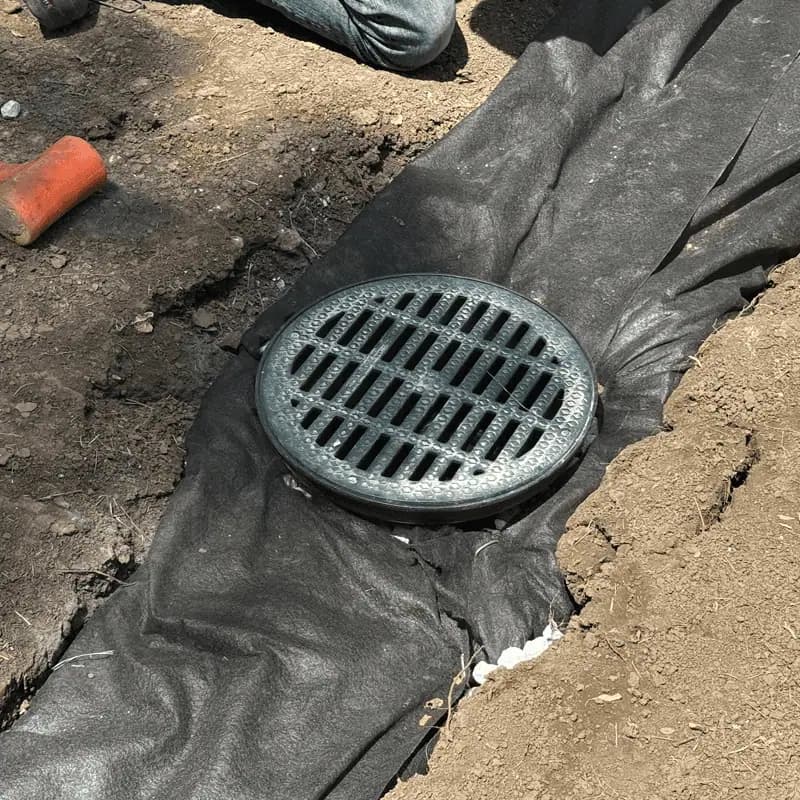
Nonwoven vs woven vs sock vs nothing
| Option | How it performs | Our take |
|---|---|---|
| Nonwoven geotextile (wrapped trench) | Felt-like fabric that lets water through freely and holds back fine soil on every side of the stone. | What we use. The right choice for almost every drain. |
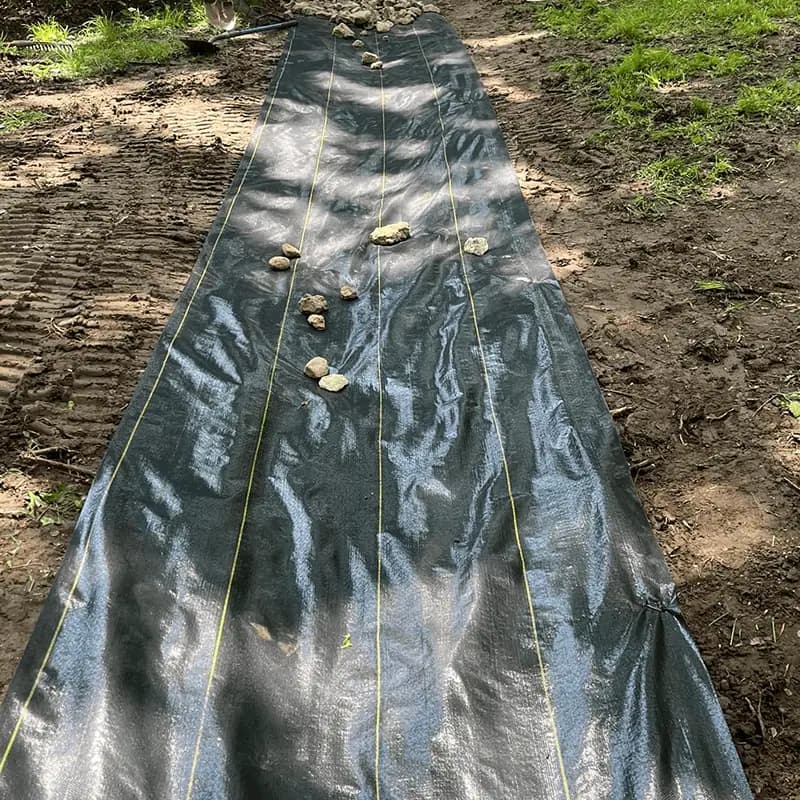
| Woven geotextile | Very strong, but water moves through it much more slowly. | Made for stabilizing driveways and roads, not for drainage. |
| Weed-barrier landscape fabric | Often plastic or tightly woven. Built to stop weeds, not to pass water. | Avoid. It can hold water out of the drain. |
| Pipe sock | Wraps only the pipe. The stone around it still fills with silt, and the mesh can clog. | We replace these regularly a few years after they go in. |
| No fabric | Works at first, then slowly silts up from the sides and top. | The most common reason we dig up a failed drain. |
We tested it
Rather than argue about it, we built five French drains side by side, including one with no fabric, one wrapped in woven weed barrier, and one in 4 oz nonwoven filter fabric with perforated pipe. Each got the same amount of water, timed on screen. The results did not all match our own prediction, so watch it before you buy a roll of anything.
How we wrap a French drain trench
- Dig a flat-bottomed trench with a steady fall of at least 1%, no humps or dips.
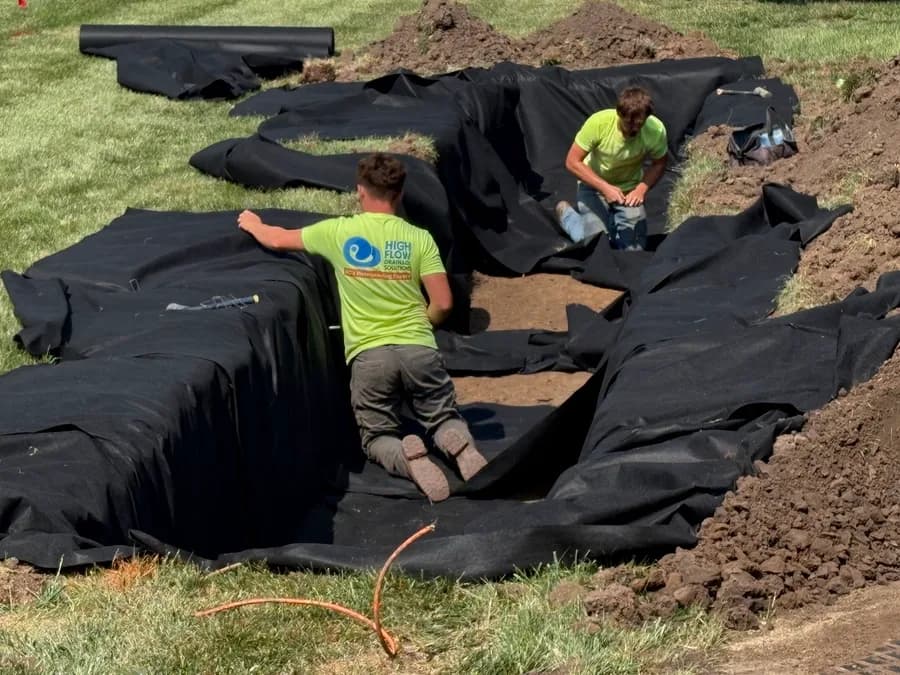
- Lay the fabric along the entire trench, across the bottom and up both sides, and pin it in place with landscape pins. Leave enough at the top to fold back over.
- Set the perforated pipe at the very bottom, on the fabric.
- Fill with clean gravel to 4 to 6 inches below the finished grade. See best gravel for drainage for which stone.
- Fold the fabric over the top of the gravel so it overlaps, trim anything that overlaps by more than about 2 inches, cut around any catch basin openings, and pin it.
- Backfill with 4 to 6 inches of soil to match the surrounding grade, then seed or sod.
The one exception is an open French drain, where the stone runs all the way to the surface to catch surface water. There the fabric lines the bottom and sides but is not folded over the top.
Fabric is not the only thing that clogs a drain
Fabric keeps soil out of the sides. It does nothing about leaves and roof grit poured in from a downspout, which is one reason downspouts get their own solid pipe rather than draining into the French drain. Too little slope, the wrong stone, and pipe that crushes are the other usual suspects. We go through all of them in 11 French drain mistakes we are hired to repair.
Frequently Asked Questions
Do you really need fabric in a French drain?
Almost always, yes. Without fabric, fine soil washes into the gaps between the stones every time it rains. Over a few years the gravel fills with silt, water stops moving through it, and the drain quietly stops working. Fabric is a small part of the cost and the main reason a drain lasts.
Can I use landscape fabric from the garden center?
Not the usual kind. Most garden-center landscape fabric is a woven or plastic weed barrier, made to stop weeds rather than to pass water. Look for nonwoven geotextile, which looks and feels like felt.
Is a pipe sock enough instead of wrapping the trench?
We do not recommend them. A sock wraps only the pipe, so the stone around it still fills with silt, and the sock's fine mesh can clog against the pipe. We regularly dig up socked drains a few years after a landscaper installed them and replace them with a wrapped trench.
Does the fabric go on the bottom of the trench too?
Yes. It lines the bottom and both sides, then folds over the top of the gravel before the soil goes back. Water can enter through any face, and so can silt, so every face gets covered.
How wide should the fabric roll be?
Add up the trench bottom, both sides and the top, plus a couple of inches of overlap. A trench 6 inches wide and 12 inches deep needs about 3 feet of fabric. The same trench at 18 inches deep needs about 4 feet. Standard 3-foot rolls only suit shallow, narrow trenches.
How much does French drain fabric cost?
Nonwoven geotextile runs roughly $50 per 100 feet. On a professionally installed drain it is one of the smallest line items, and skipping it is one of the most expensive mistakes.
Doing it yourself, or want it done once?
The French drain cost calculator includes fabric in its material estimate. If you would rather have it built right the first time, see our French drain installation service, book a free estimate, or call (816) 826-8794.