
Your sump pump is doing its job. It’s pulling water out of the pit and pushing it up and through the discharge line. But if that line ends four feet from your foundation, all you’ve done is take a short lap around the house. The water soaks right back into the soil, the drain tile collects it, the pit fills again, and the pump kicks back on.
A sump pump drainage extension fixes that. It carries the water far enough away from your home that it can’t find its way back, protecting the foundation and giving the pump a real break between cycles.
Why the Water Has to Go Far Away
When your pump discharges right next to the house, that water saturates the soil around the foundation. On Kansas City’s heavy clay, it doesn’t drain down. It sits there, pressing against the foundation wall. That’s called hydrostatic pressure, and it’s the force that pushes water through every hairline crack and cold joint in your basement.
Then the perimeter drain tile (if it works) does exactly what it was built to do. It collects that saturated groundwater near your footings and sends it straight back to the sump pit. The pump runs again. You’re moving the same gallons of water in a loop, wearing out the pump and keeping the soil around your foundation permanently wet.
Getting the water out there, really out there, is the only way to break the cycle. That’s what a proper drainage extension does.
Three Ways to Extend a Sump Pump Drain Line
There isn’t a single right answer for every property. Lot size, grade, soil, neighbor considerations, and city code all factor in. These are the three methods we install most often in the KC metro, and the situations where each one shines.
1. Pipe to a Dry Creek Bed
This is the most popular option for yards with room to work with. We run a solid pipe from the sump discharge out to a dry creek bed placed at a low point of the property, usually along a natural drainage path. The pipe dumps the water into the creek bed, which spreads it out over a wide area of river rock and allows it to disperse without eroding the yard.
The dry creek bed does double duty. It handles the pumped water, it looks intentional rather than like a random pipe end sticking out of the ground, and during heavy rains it also channels surface runoff. For homeowners who don’t love the idea of a plain pop-up in the middle of the yard, this is usually the answer.
It works best in yards with at least some natural slope away from the house. Flat lots are tougher because you need enough fall in the pipe to keep it draining.
2. Leach Bed (Underground Dispersion Chambers)
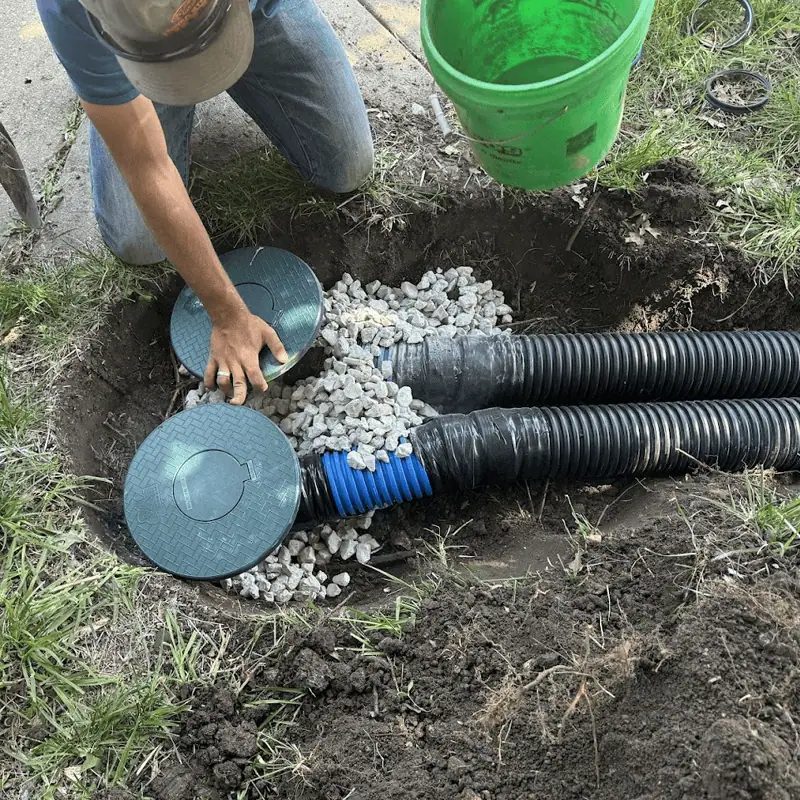
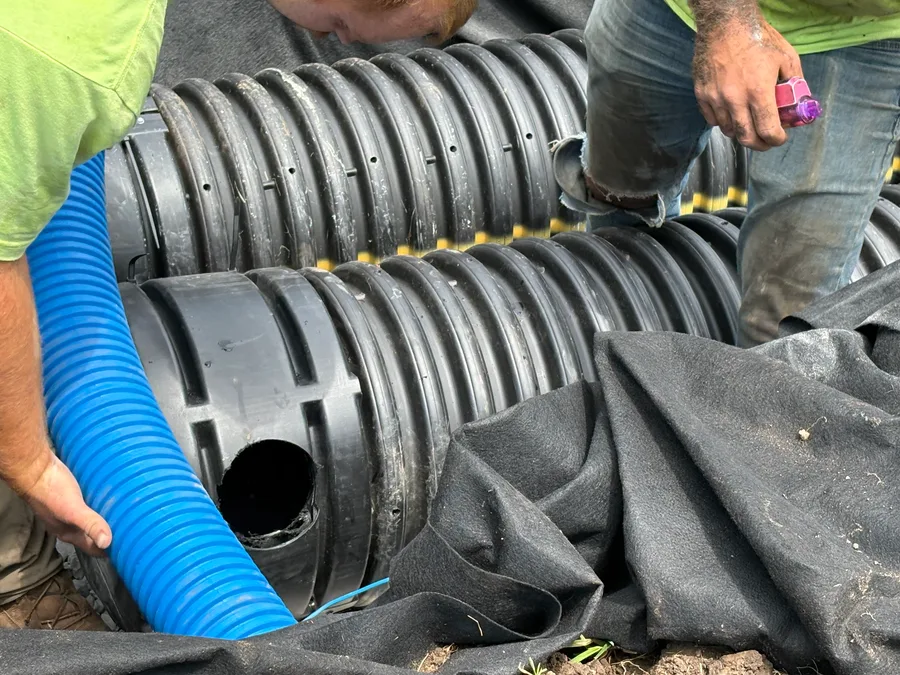
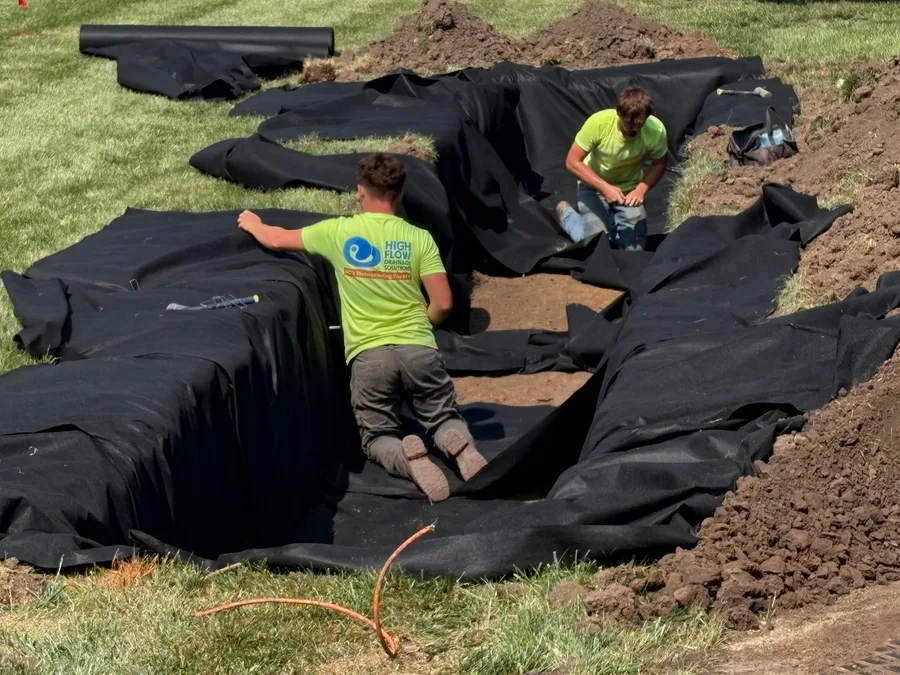
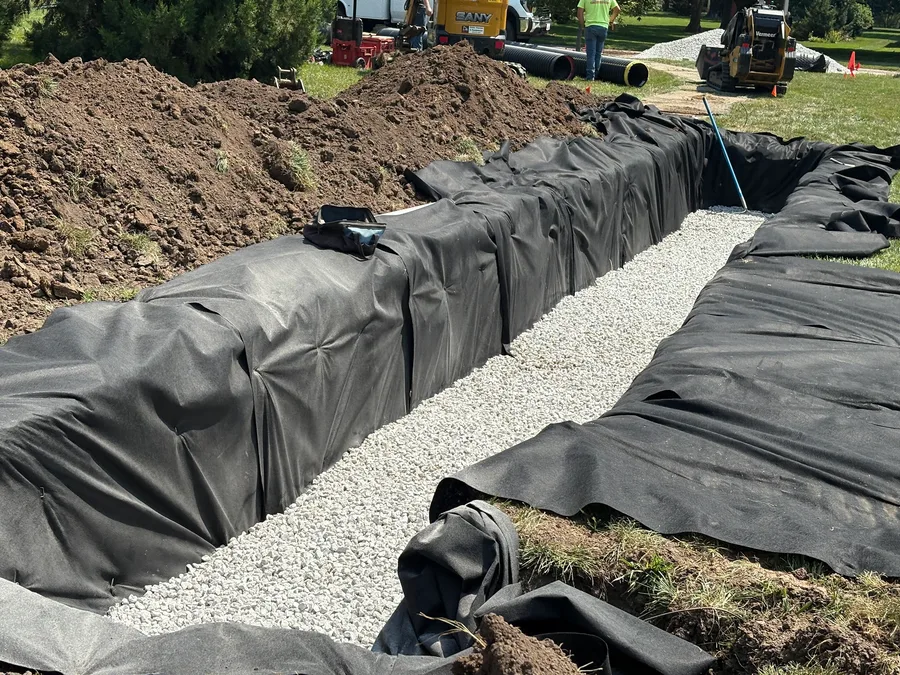
When the lot is flat, tight, or the water volume is high, a leach bed is often the better call. A leach bed is a set of large underground chambers, sometimes two runs of 30-foot, 15-inch diameter perforated pipe, buried in a gravel-wrapped bed well away from the foundation.
We pump the sump water into those chambers. The chambers hold the water temporarily, and it leaches slowly out through the perforations into the surrounding soil. Because the bed is sized for real volume and located well away from the house, the soil has time to absorb and disperse it without that water ever finding its way back to the foundation.
This is the method we lean on in neighborhoods where there’s nowhere obvious for the water to daylight. It’s underground, out of sight, and it handles serious volume. The bigger the chambers, the bigger the storm it can absorb.
3. City Drain Curb Inlet (With Permit)
In some municipalities, and with the right permit, we can tie the sump discharge directly into the city’s stormwater system at a curb inlet. The water leaves the property entirely and goes straight to the storm drain.
When it’s allowed, this is the cleanest long-term solution. No creek bed to maintain, no underground chambers, no worries about soil saturation. But it requires a city permit every time. Different cities across the metro have different rules about what can and can’t tie into the curb inlet, and some won’t allow it at all. We handle the permitting when this is the right fit, and we’ll tell you upfront if your city isn’t going to approve it.
Freeze Protection: Every Install Gets One
Kansas City winters are no joke. A sump pump drain line that freezes solid turns into a plugged pipe, and a plugged pipe in January will flood your basement as fast as a failed pump. Every drainage extension we install includes a freeze protection overflow so the pump always has a way to clear water, even if the buried pipe is iced up.
There are two approaches we use.
Old-Style Street Tee
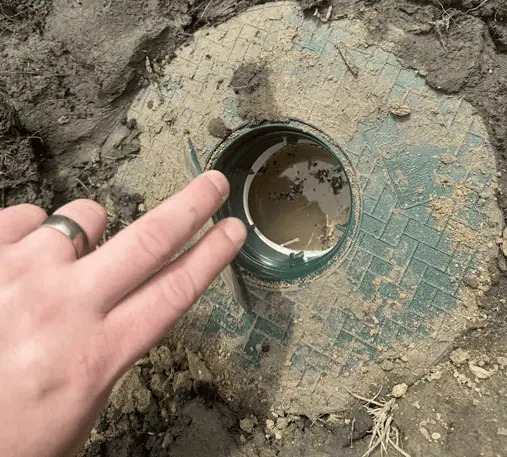
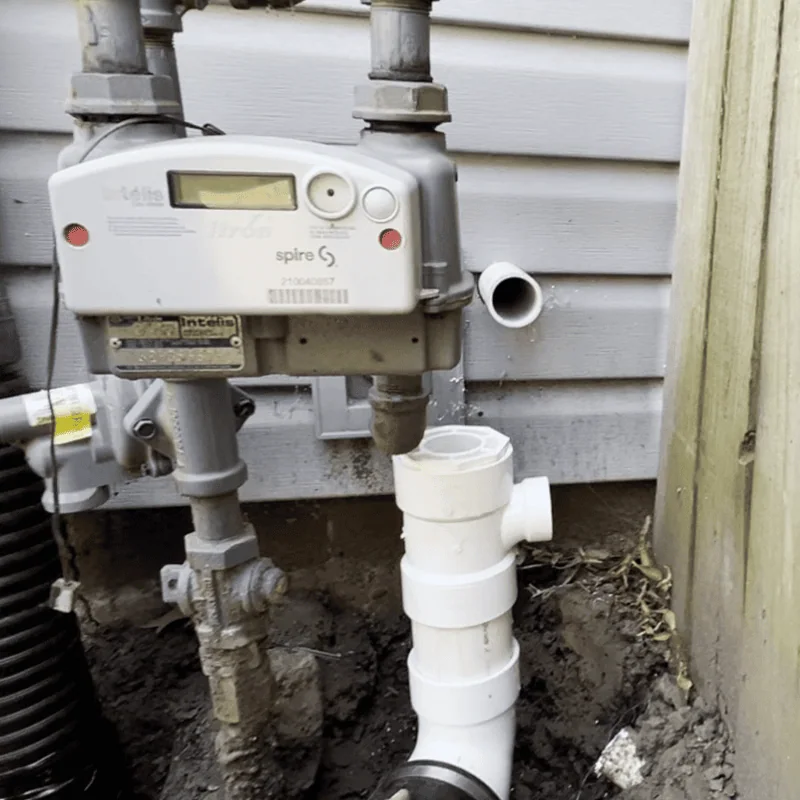
Above, you can see a PVC overflow without the piece that connects the sump pump discharge line to our overflow tee.
The traditional approach is a street tee at the exit point of the discharge, positioned so that if the downstream pipe freezes, water backs up and spills out of the tee onto the ground next to the house. It’s not elegant, and yes, it dumps water close to the foundation when it’s in use, but the alternative is a basement flood. In a freeze emergency, that tradeoff is obvious. Once the pipe thaws, the tee goes back to being a quiet part of the system.
Street tees still work, and plenty of older installs around KC are running on them without issue.
New-Style Waffle Overflow

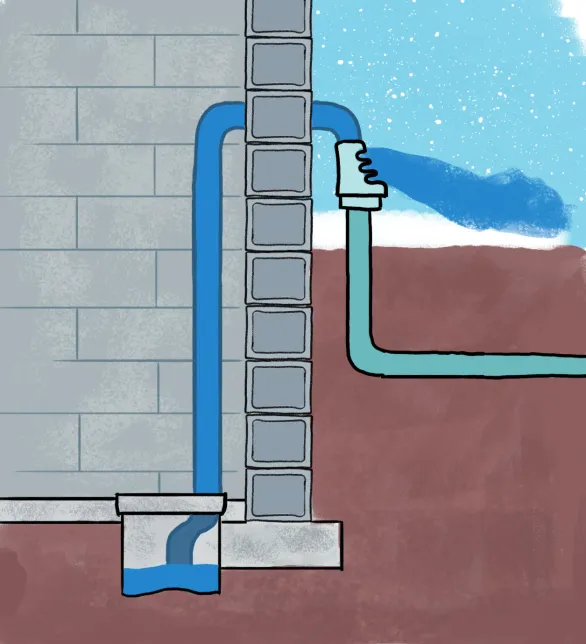
The newer design we install is a waffle-style overflow. It sits at the transition point between the pump discharge and the buried extension, and it’s engineered to release water cleanly if there’s any backpressure from a frozen or blocked downstream line. The profile is lower, the release path is cleaner, and it looks a lot better next to you rhouse than a standard plumbing.
On new installs, this is what we usually recommend. Same purpose as the street tee, better execution.
Our Process
We don’t pull up to every house with the same plan.
- Assess the property. We look at how much water the pump is actually moving, where it can realistically go, the grade, the soil, the lot layout, and what your city allows.
- Design the extension. Dry creek bed, leach bed, or curb inlet tie-in, whichever fits the property and the water load. We size the pipe, plan the route, and pick the freeze overflow style that works for your yard.
- Install it right. Proper pitch, solid pipe (no corrugated dishwasher hose we’ve seen buried three feet down on fix-it calls), freeze protection integrated at the right spot, and clean restoration of the yard when we’re done.
Every install is backed by our 10-year workmanship warranty.
Common Questions
How far does the sump discharge need to go from the house?
Further than most people think. A few feet isn’t enough. On clay soil, we want the water landing or dispersing at least 20 feet from the foundation at a minimum, and often much further. The exact distance depends on grade, soil, and where the property’s natural low points sit.
Can I just use the pop-up emitter the builder left me?
Sometimes those are fine, sometimes they’re the whole problem. A lot of the ones we see are too close to the house, clogged with silt, or frozen shut half the year. If yours is working and sending water far enough out, great. If your pump is cycling constantly or your basement is getting damp, the pop-up is worth a second look.
Will the extension freeze in winter?
The buried portion runs close to the frost line and flowing water has a higher freeze point, which protects it most of the time. The vulnerable spots are where the pipe surfaces and where it discharges. That’s exactly why we install a freeze protection overflow on every job. Even if the exit ices up during a cold snap, the pump still has somewhere to send water.
Do I need a permit?
For a dry creek bed or leach bed on your own property, generally no. For tying into a city curb inlet, yes, and it varies by municipality. We handle the permitting when it’s required and let you know upfront what your city allows.
My yard is almost completely flat. Which option works for me?
Leach beds are sometimes the answer on flat lots. You don’t need slope to get water out because the system holds the water underground and lets the soil absorb it over time. Dry creek beds need some fall to work, so on a truly flat yard they’re not always the best fit.
What if water starts pooling where the extension ends?
Either the method isn’t matched to the volume (a creek bed where a leach bed was needed), the outlet is in the wrong spot, or the soil in that area is saturated and can’t take any more. We size every system to the actual water load the pump produces, which is why the assessment up front matters.
Let’s Get Your Sump Water Where It Belongs
A sump pump with a bad discharge is a pump fighting a losing battle. The fix is almost always in the extension, not the pump itself. We’ll come out, look at your setup, measure the water volume, and lay out exactly what it’ll take to get the water clear of the foundation for good.
Dry creek bed, leach bed, or curb inlet tie-in, with a freeze overflow that’ll hold up through a KC winter. Permanent solutions, not quick fixes.