

A pop-up emitter is the round lid you see sitting flush in a lawn at the end of a buried drain line. When water flows down the pipe, the pressure pushes the lid up and the water spills out across the grass. When the flow stops, the lid drops back down and keeps out dirt, leaves and animals. It is the most common way to finish a buried downspout, a sump pump line or a French drain.
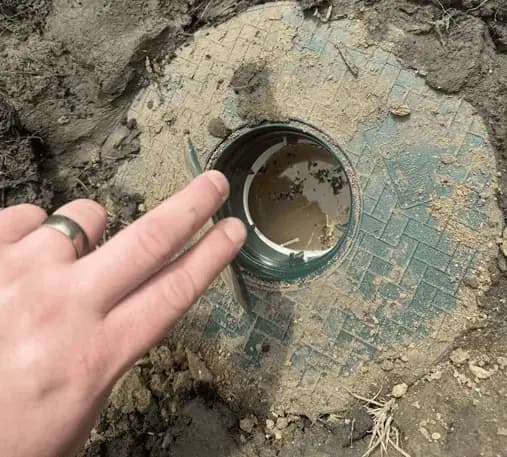
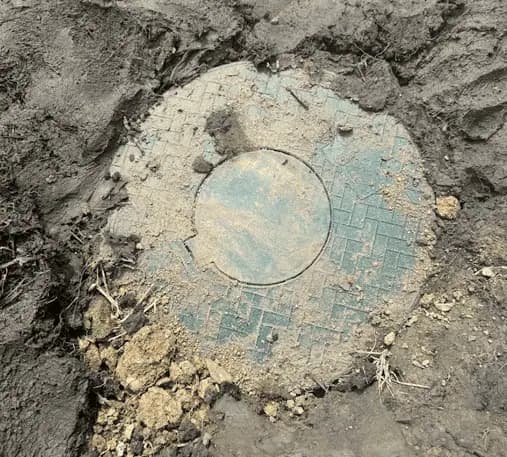
How a pop-up emitter works
An emitter is an elbow that turns the pipe upward, with a hinged or floating lid on top. It only works if the water has enough push to lift that lid, which means two things have to be true:
- The emitter is lower than where the water starts. A buried line has to fall all the way from the downspout or pump to the emitter. If the emitter sits higher than the start of the line, water stalls in the pipe and backs up.
- The line is sealed. Pop-ups belong on solid pipe. On perforated pipe most of the water leaks out along the way and never reaches the lid.
How we install them
These are the steps our crew follows on every pop-up we set.
- Screw the elbow to the emitter on both sides with corrosion-resistant screws, so frost and mowers cannot pull it apart.
- Drill a 3/8-inch weep hole in the bottom of the elbow, so the last of the water drains out slowly instead of standing.
- Dig the discharge end at least 12 inches deep and lay 4 to 6 inches of gravel where the emitter will sit, so the weep hole drains into stone, not mud.
- Set the top 1 to 2 inches below grade, so it finishes flush with the lawn once the grass fills in and the mower rides over it.
- Pack the soil firmly under the plate so it stays level and does not sink or tip over time.
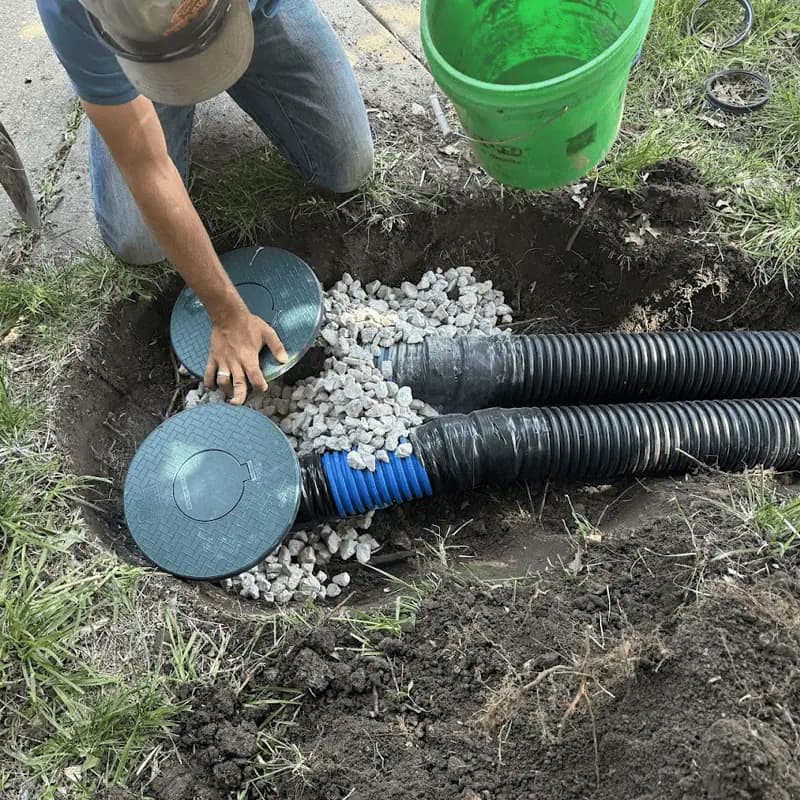
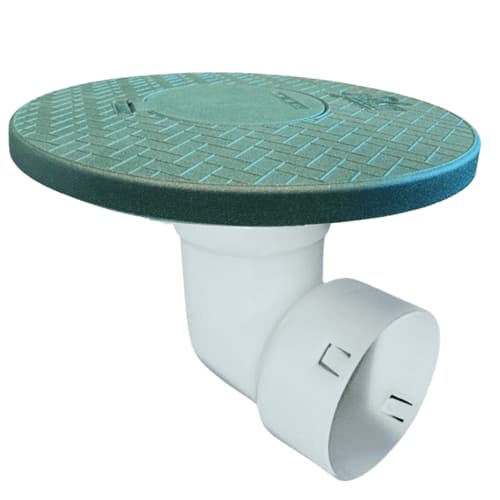
Five reasons pop-up emitters fail
- No weep hole. Water sits in the elbow, smells, breeds mosquitoes, and freezes into a plug in winter.
- No gravel under it. The weep hole drains into mud, and mud works back up into the elbow until it clogs.
- Set too high. The mower catches the lid and cracks it, or the whole emitter gets pulled loose.
- Not enough fall. The emitter sits level with or above the start of the line, so water never has the push to open it.
- Too much water for one outlet. Several downspouts or a busy sump pump into a single emitter overwhelms it, and the excess backs up the line. Bigger flows get more than one emitter, or a different outlet altogether.
We cover more installation mistakes in French drain mistakes we are hired to repair, and the emitter we prefer in our French Drain Man product review.
Pop-up emitter vs daylight outlet vs dry well
A pop-up is one of three ways to finish a drain line. The right one depends on how much fall your lot has.
| Outlet | What it does with the water | Best when |
|---|---|---|
| Pop-up emitter | Returns it to the surface through a lid in the lawn. | There is enough fall to reach a spot well away from the house, and you want a clean finish in the grass. |
| Daylight outlet | The open end of the pipe, cut at an angle, discharges onto a slope or into a ditch. | The lot drops away steeply enough for the pipe to come out of the hillside. |
| Dry well | Ends it. Water soaks into the soil underground. No outlet. | There is nowhere lower to send the water, and the soil will absorb it. |
A dry well does not feed a pop-up, and a pop-up is not the end of a dry well. They are two different answers to the same question. When there is no fall at all and the soil will not absorb water, an outdoor sump pump lifts it out instead.
Frequently Asked Questions
Why does my pop-up emitter always have water sitting in it?
Because there is no way for the last of the water to leave. Once the flow stops, whatever is left in the elbow and the end of the pipe sits there. We drill a small weep hole in the bottom of the elbow and set it on gravel so that water slowly drains into the ground instead of standing, breeding mosquitoes and freezing.
Do pop-up emitters freeze in winter?
They can, especially on sump pump lines that run all winter. A weep hole and a gravel base keep standing water out of the elbow, which is what freezes first. On sump lines we also put a freeze-protection overflow fitting at the house, so a frozen emitter cannot back water up into the pump.
How far from the house should a pop-up emitter be?
Far enough, and low enough, that the water cannot run back to the foundation. That usually means well out into the yard or toward the street, at a point lower than where the pipe starts. The exact distance depends on the slope of your lot.
Can I mow over a pop-up emitter?
Yes, if it sits 1 to 2 inches below the surrounding grade with the soil packed firmly under the plate. Emitters set high get clipped by mowers and cracked, which is one of the most common replacements we do.
What does a pop-up emitter cost?
The emitter itself is an inexpensive part. Added to a drainage system we are already installing, a riser and pop-up is a line item of about $150 on our recent quotes. The real cost is the buried line that feeds it.
How do I clean out a pop-up emitter?
Lift or unscrew the lid, scoop out leaves and mud, and flush the line with a hose from the upstream end. If it keeps clogging, the line needs a filter where water enters it, such as a downspout filter or a catch basin with a basket.
Emitter not working?
A pop-up that never opens, or one that floods every time it rains, usually points to a problem with the line that feeds it. We can find out why and fix it. Book a free estimate or call (816) 826-8794.