

You’re standing in the drainage aisle looking at a coil of black corrugated pipe, a stack of white PVC, and a roll of something wrapped in what looks like a tube sock. The labels say “4 inch perforated” and “6 inch solid” and “corrugated drainage pipe,” and none of it tells you which one belongs in your yard.
Here’s what nobody explains before you get to the register. Corrugated versus perforated is not a choice. Those are two different questions, and you have to answer both.
These Are Two Separate Decisions
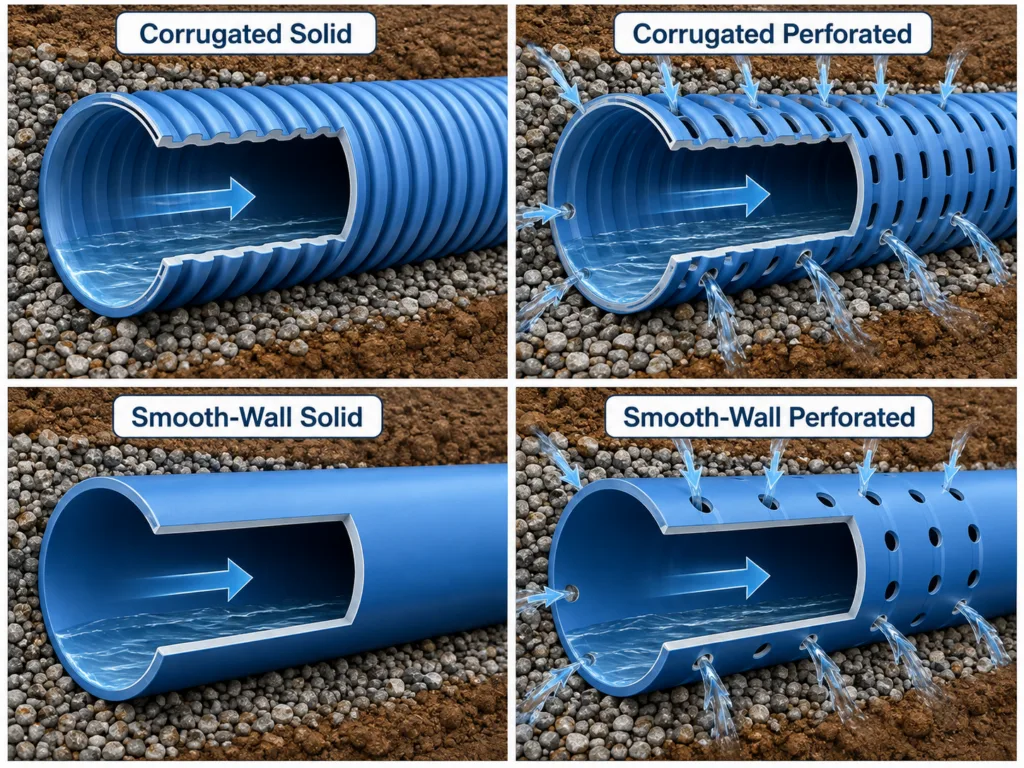
Corrugated is a description of the pipe wall. Ribbed and flexible, sold in coils, as opposed to rigid PVC in straight lengths with glued fittings.
Perforated versus solid is a question about holes. Does the pipe have slots punched in it so water can seep in, or is it sealed so water can only go in one end and out the other?
Corrugated perforated. Corrugated solid. Perforated PVC. Solid PVC. All four exist, all four sit on the same shelf, and picking the wrong combination is how people end up watering their own foundation on purpose.
So take it in that order. First decide whether water needs to get into the pipe. Then worry about what the pipe itself is.
Perforated or Solid: Does Water Need to Get In?
Perforated pipe is for collecting. Solid pipe is for transporting. That’s the whole rule, and it holds up on every job we do.
Perforated drain pipe belongs anywhere the goal is to pull water out of saturated soil. A French drain is the obvious one. The pipe sits in a rock-filled trench, groundwater migrates into the rock, drops through the slots, and gets carried off. Same logic for footing drains and perimeter drain tile around a basement. Those pipes are supposed to leak inward. That is their job.
Solid pipe belongs anywhere the water is already captured and you just need to move it. Downspout lines. Sump pump discharge lines. The run from a catch basin out to the curb.
Now picture getting that backwards.
We pull perforated pipe off downspout lines more often than you’d think. Somebody buries a perforated line from the gutter, runs it fifteen feet, calls it done. Except a downspout on a decent-sized roof moves hundreds of gallons in one storm, and that pipe is releasing all of it through slots the entire way. In clay it doesn’t soak in and vanish. It saturates a loose backfilled trench running right alongside your foundation. You didn’t drain your roof. You installed an irrigation system pointed at your basement wall.
Solid pipe for buried downspout. Every time.
The Real Divide Isn’t Corrugated vs. PVC
This is where most articles tell you to skip corrugated and run rigid PVC. We don’t, and we’ve dug up enough of both to feel good about saying so.
We install corrugated pipe. Just not the corrugated pipe you’re looking at in that aisle.
The thin black coil at the box store that a lot of landscapers and new home-builders use… and the heavy-duty corrugated pipe a drainage contractor buys are two genuinely different products that happen to look alike in a photo. Ours comes from French Drain Man, and the difference is obvious the second you pick up a length of each. You can flatten the hardware store pipe with one hand. You can’t do much of anything to ours with two.
That distinction resolves most of the standard complaints about corrugated.
Wall thickness answers the crush-and-sag problem
The knock on corrugated is that it deforms. Backfill compaction squeezes it oval, a truck crosses the line and flattens it, and it sags between high points because nothing holds the run straight. All true, and all true of thin-wall coil pipe specifically.
Heavy-wall pipe holds its shape. It takes compaction without going out of round, it stays where we set it on a graded trench bottom, and it doesn’t develop the bellies that turn into standing water and then, in January, into an ice plug.
Smooth interior where the water is moving fast
On the solid runs, the lines carrying captured water from point A to point B, we use dual-wall pipe. Corrugated on the outside for strength, and more smooth on the inside for flow. It moves as much water as rigid pipe at the same slope, and sediment rides through instead of settling into ribs.
So the friction argument and the silt argument, which are real arguments against cheap single-wall pipe, don’t apply to what actually goes in the ground on our jobs.
Bigger openings on the collection pipe
In the French drain itself, we run heavy-duty perforated corrugated. The slots are larger and there are more of them than on box store pipe, which matters more than people realize. A collection pipe’s job is to take water in fast. Narrow pinhole slots are a bottleneck the day you need the drain most.
It moves with our soil
This reason one is Kansas City local. Clay swells when it’s wet and shrinks when it’s dry, and around here it does both hard, sometimes in the same month. Rigid pipe with glued joints doesn’t have anywhere to go when the ground shifts around it, and joints are where rigid systems come apart. A continuous run of corrugated flexes with the soil and has almost no joints in it to begin with.
It also curves around a mature oak’s root plate or an irrigation line without a single fitting, which means a shorter trench, less root damage, and fewer places for the system to fail.
None of this is an argument for cheap pipe. Pipe is a small fraction of what a drainage job costs anyway. Trenching, rock, labor, restoration, that’s where the money goes. Saving forty dollars on a coil and re-digging the same trench in six years is not a savings.
About the Sock
Perforated pipe wrapped in a filter fabric sleeve, the “sock,” is sold as insurance against clogging. The pitch makes sense on its face. Fabric keeps dirt out of the holes.
In our clay, we think it’s usually a mistake.
The sock is a fine mesh sitting directly against the pipe. The particles that cause trouble here are clay fines, extremely small, and they travel with water. They reach that fabric, they don’t pass through, and they don’t wash away either. They build up on it. What you end up with is a pipe wrapped in a progressively less permeable layer of clay. The failure isn’t dirt in the pipe. It’s a pipe sealed shut from the outside, and you can’t see it happen and you can’t clean it out.
Better to keep the fines from ever reaching the pipe. Clean, washed, angular rock with no fines in it, and non-woven filter fabric wrapped around the entire trench, well outside the rock. The fabric still does its job, just across a large surface area instead of a tiny one. If part of it blinds over, water has plenty of other fabric to move through.
The rock matters as much as the pipe here. More on that in our guide to the best gravel for drainage, and skipping washed rock is one of the more common French drain mistakes we get called out to repair.
Socked pipe has a place. Sandy, well-draining soil, sure. That is not most of this metro.
4 Inch or 6 Inch?
Four inch handles the majority of residential work. A typical French drain, a single downspout line, a run off one catch basin, four inch is plenty of capacity as long as the slope is right.
Go to six inch when you’re combining flows or moving a lot of water in a hurry. Two or three downspouts tying into one main line. A long run collecting from multiple inlets. A property taking on runoff from uphill neighbors. Six inch also buys margin: a four inch line 60 percent full of sediment is nearly dead, while a six inch line in the same shape still moves water.
Slope matters more than diameter, though. A six inch pipe running dead flat will lose to a four inch pipe with proper fall, so aim for roughly an inch of drop every eight to ten feet and get that right first.
How This Looks on a Real Job
A typical house we work on ends up with both types in the ground. Heavy-duty perforated corrugated in the French drain along the wet side of the yard, bedded in washed rock, whole trench wrapped in fabric, no sock. Solid dual-wall running from the buried downspouts and off the end of that French drain, carrying everything to a discharge point well away from the house.
Same manufacturer, same trench crew, two different pipes doing two different jobs.
Collect with holes. Transport without them. Once you see the pattern, the box store aisle gets a lot less confusing.
Common Questions
Can I use corrugated pipe for a French drain?
Yes, and we do on every job. The question is which corrugated. Thin-wall coil pipe from the hardware store moves water on day one and then goes oval, sags, and silts up by year six. Heavy-duty perforated pipe in washed rock, on real slope, is what we’d put in our own yard.
What’s the difference between single-wall and dual-wall?
Single-wall is ribbed inside and out. Dual-wall has the same corrugated exterior but a smooth interior bore. We use heavy single-wall perforated where the pipe’s job is collecting water out of the trench, and solid dual-wall where its job is carrying that water somewhere fast without leaving sediment behind.
Is black corrugated pipe the same as perforated pipe?
No, and that’s the whole confusion. Black corrugated pipe comes in both perforated and solid versions. Corrugated describes the wall. Perforated describes the holes. Read the label, because they’re stocked right next to each other.
Which way do the holes face?
We use pipe with holes on all sides, so we don’t have to focus on orientating the pipe, as well as giving the water more surface area to enter the pipe.
Still Not Sure What Your Yard Needs?
Picking the pipe is the easy part. The hard part is reading the water: where it comes from, where it’s headed, and what it does in a storm that dumps three inches in ninety minutes. That’s what we do every day across the metro, from Lee’s Summit to Olathe to Liberty, and it’s what we stand behind with a 10-year workmanship warranty.
If you’ve read this far and started to suspect the job is bigger than a coil of pipe from the hardware store, that’s a good instinct. Let us come look at it.