

You know you have a water problem. You’ve done some research. And now you’re stuck between two solutions that keep coming up: French drains and catch basins. They both deal with water. They both go in the ground. But they work in very different ways, and choosing the wrong one means spending money on a system that doesn’t actually solve your problem.
We install both of these every week across the Kansas City metro. Here’s how to think about which one you actually need.
What Is a French Drain?
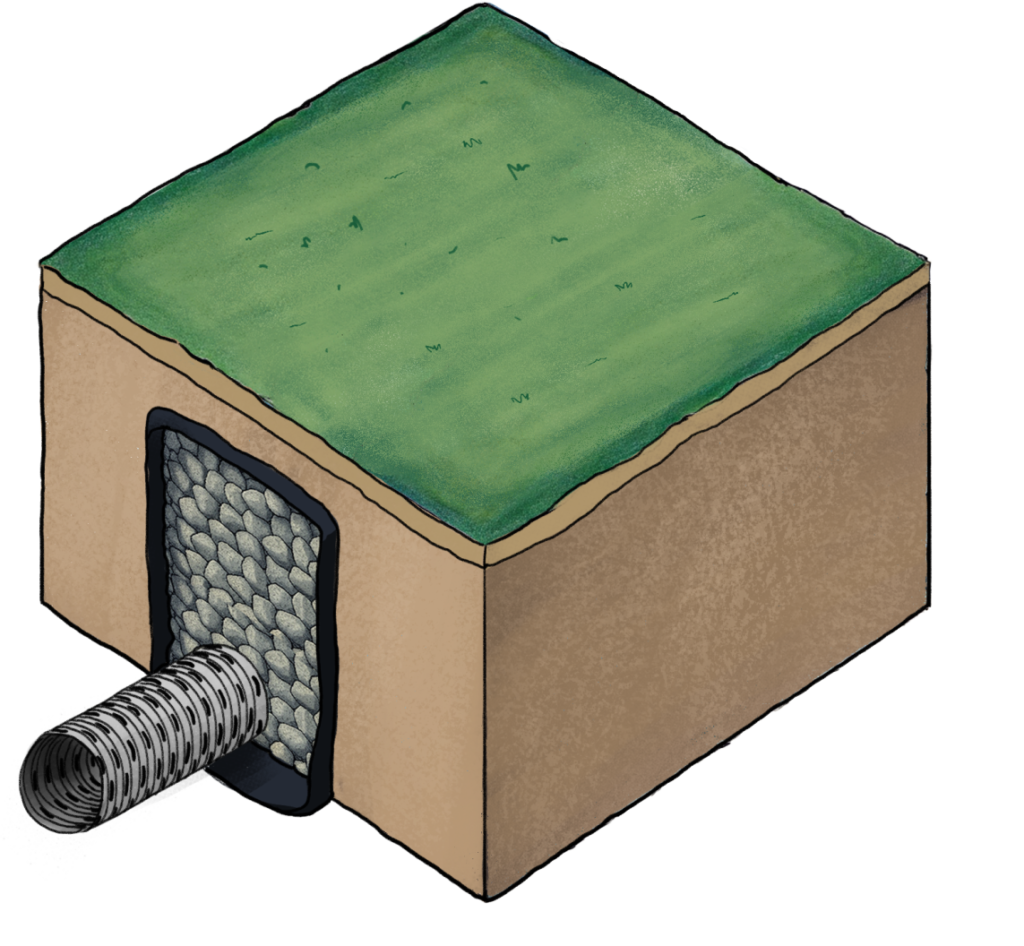
A French drain is a trench filled with gravel that contains a perforated pipe. It sits below the surface and collects water that’s soaking through the ground. Think of it as an underground interceptor. Water that’s moving through the soil hits the gravel, filters into the perforated pipe, and gets carried away to a discharge point.
The key thing about a French drain is that it handles subsurface water. The water you can’t see. The water that’s saturating the soil, creating hydrostatic pressure against your foundation, and keeping your yard soggy for days after it rains.
In Kansas City, French drains are one of the most common solutions we install because of our clay soil. Clay doesn’t let water pass through on its own easily, so a French drain gives that trapped water somewhere to go. You can read more about how we install them on our French drain installation page.
What Is a Catch Basin?
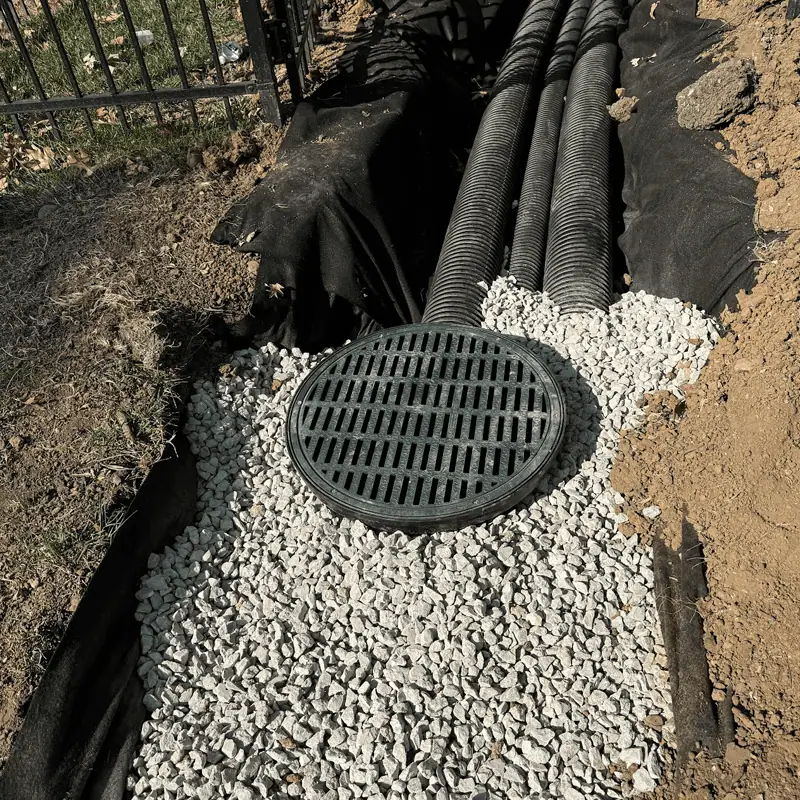
A catch basin is a surface-level inlet, basically a box with a grate on top, that collects standing water and channels it into an underground pipe that carries it away. If you’ve ever seen a storm drain on the street with a metal grate over it, that’s the same concept scaled down for residential use.
Catch basins handle surface water. The water you can see pooling in a low spot, collecting at the bottom of a slope, or flooding a specific area of your yard after a storm. The grate sits flush with (or a little below) the ground, water flows into it by gravity, and the pipe routes it to a safe discharge point.
Learn more about how we use these on our catch basin installation page.
The Core Difference
This is the simplest way to think about it:
French drains collect water underground. They intercept water that’s moving through the soil before it becomes a visible problem.
Catch basins collect water on the surface. They capture water that’s already pooling where you can see it.
A French drain is like a filter that pulls water out of saturated ground. A catch basin is like a funnel that grabs water off the top and sends it somewhere else.
Different problems, different tools.
When a French Drain Is the Right Call
Your yard stays wet and spongy for days after rain, even though there’s no visible standing water. The ground is saturated below the surface, and it just won’t dry out. This is the classic sign that you have a subsurface water problem, and a French drain is built for exactly that.
Other situations where a French drain makes sense:
- Water is seeping into your basement through the walls or cove joint
- You need to intercept water that’s moving underground toward your foundation
- Your yard has a broad area that stays soggy, not just one specific spot
- You’re dealing with a high water table or clay soil that won’t drain (which is most of the KC metro)
- A retaining wall needs drainage behind it to prevent failure
French drains are especially effective when the problem is spread across a larger area. They can run 30, 50, 80 feet or more across a yard, intercepting water along the entire length.
When a Catch Basin Is the Right Call
You’ve got a specific spot where water visibly collects. Maybe it’s a low point at the bottom of a slope, a depression in the middle of the yard, or a corner where runoff from the driveway and roof all converge. You can point to it and say “that’s where the water goes every time it rains.”
Catch basins work best for:
- A defined low spot that floods after every rain
- Collecting runoff from driveways, patios, or walkways
- Areas where multiple water sources converge into one spot
- Managing surface flow in areas with hardscaping that creates runoff
- Connecting to a larger underground drainage system as an inlet point
Catch basins are targeted. They solve a specific, localized pooling problem. They’re not designed to manage water that’s spread through the soil across a wide area.
Can You Use Both? (Yes, and We Often Do)
Here’s what a lot of online articles won’t tell you: most drainage projects we do in Kansas City use some combination of solutions, not just one or the other.
A catch basin at the low spot in the yard, connected to a French drain that runs along the side of the house, tied into a buried downspout line that carries everything to the street or a pop-up emitter at the back of the property. That’s not unusual. That’s just what good drainage design looks like when you’re solving the whole problem instead of just one piece of it.
We take a holistic approach. We look at where the surface water is going, where the subsurface water is going, what the grading is doing, and how the roof runoff factors in. Then we design a system that addresses all of it.
Quick Comparison
| French Drain | Catch Basin | |
|---|---|---|
| Handles | Subsurface (underground) water | Surface (visible pooling) water |
| Best for | Broad soggy areas, foundation protection, saturated clay soil | Specific low spots, runoff collection points |
| Visibility | Hidden below ground (only gravel strip visible) | Grate visible at surface level |
| Coverage area | Can span long distances across a yard | Targeted to one collection point |
| Maintenance | Minimal when properly installed | Occasional clearing of debris from grate |
| Works in clay soil? | Excellent, designed for it | Yes, but only for surface water |
The Mistake We See Most Often
Homeowners (and sometimes contractors who don’t specialize in drainage) install a catch basin in a yard that’s soggy everywhere. It doesn’t work. The catch basin sits there collecting a little bit of surface water while the real problem, the saturated soil underneath, goes completely unaddressed. A few weeks later the yard is still a swamp and they’re wondering what went wrong.
The reverse happens too. Someone installs a French drain to fix a single low spot that floods after every rain. The French drain handles the subsurface moisture fine, but the surface water still pools because there’s nothing to capture it off the top. A catch basin would have been the simpler, more effective solution for that specific problem.
This is why diagnosis matters more than the product. Water doesn’t lie, but you have to read it correctly.
Common Questions
Do I really need a professional, or can I install one myself?
You can buy the materials at a hardware store, sure. But the difference between a drainage system that works for 10 years and one that fails in 18 months is in the details: the slope of the pipe, the type of gravel, the placement, the discharge point. In KC’s clay soil especially, a system that isn’t designed right won’t drain. We’ve repaired a lot of DIY installs and we’re always honest about what went wrong. Usually it’s one of those details.
How long do these systems last?
A properly installed French drain or catch basin system should last decades. We use quality materials that we’ve tested across hundreds of jobs, and we back our work with a 10-year workmanship warranty.
Will installing one of these mess up my yard?
There’s trenching involved, so yes, your yard will look like a construction zone for a day or two. But we clean up after ourselves, and most yards recover quickly once the grass grows back in. The end result is a yard that’s actually usable instead of a mud pit.
What does it cost?
It depends on the scope. A single catch basin is a smaller job than a 60-foot French drain system. We provide detailed estimates with transparent pricing after evaluating your property. Best way to get a real number is to book a free consultation.
Not Sure Which One You Need? We’ll Help You Figure It Out.
That’s literally what the consultation is for. We’ll walk your property, look at where the water is going and why, and recommend the right solution. Maybe it’s a French drain. Maybe it’s a catch basin. Maybe it’s both plus some grading work. Whatever it is, you’ll understand exactly what we’re recommending and why before any work starts.